Uh, Steve? I think someones already using that. Yes, this year. Yeah, I'm pretty sure its a big deal. Are you sure? I mean, we could think of another-- Okay, fine. We'll keep it, but it better be good.
This is how I imagine the conversation went when Steve announced his intention to name his latest album after his favorite childhood storybook.
//Oh God, I wish I was funny..
Its backstory time.
Steve's first experience in the world of music came when he was only ten years old, when his parents persuaded him to take up the (don't laugh) accordion (I did not make that up.) However, after hearing one of his sister's Led Zeppelin records, he devoted himself entirely to the electric guitar. In the early 70s, Steve even managed to receive lessons from another highly critically acclaimed guitarist, Joe Satriani, who would later become a lifelong friend and partner in many endeavors. He then went on to attend Berklee College of Music, graduating in 1979.Vai has quite the history, weaving through many different highly respected players and artists, and has become highly critically acclaimed as well as an inspiration to many an amateur guitarist.
Highly interested in the music of the legendary Frank Zappa, Vai made it his goal to attract Frank's attention. He decided the best way to do this was by transcribing, by hand, all of Frank's incredibly complex piece The Black Page, and mailing that to the Zappa residence. This transcription was eerily accurate, and impressed Frank enough to take on a young Vai to transcribe more guitar parts (excerpts of which are floating to the left as part of this blog layout) for what eventually became the official Frank Zappa Guitar Book.
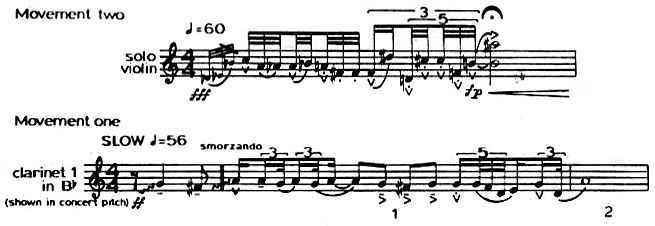
//For anyone absolutely far too interested, I actually lifted both pieces for this blog's layout from Vai's work, the first being a chunk of the original Black Page transcription and the second being the second Violin solo from Mo 'n Herb's Vacation off of Zappa's first London Symphony Orchestra album (ref).
While working to transcribe all the absolutely ridiculous parts that Frank threw at him, Zappa began to recognize Vai's his potential as a guitarist, and eventually granted him status as a full-fledged band member. He appeared on several Zappa albums, before leaving the band to be recruited by David Lee Roth (after his recent estrangement from Van Halen) as the guitarist for his first solo album. Vai was compared very favorably in the press to Eddie Van Halen, making not only a name for himself, but also launching a career for his teacher Joe Satriani in the process.
After a short ordeal with Whitesnake (which he has never seemed too happy about), Steve began recording mostly instrumental solo albums which have garnered him incredible respect and esteem amongst amateur guitarists and musicians of all variates for generations. His second release, Passion and Warfare, immortalized him the eyes of many guitarists as one of the next greats. His sometimes comical approach to songwriting stood in direct contrast with serious musical ambitions, and highly technically proficient guitar parts, creating something truly unique.
"For example, for 'Down Deep into the Pain' from his new album Sex & Religion, Vai worked with a scale he created which divides the octave into 16 equal divisions instead of the 12 divisions of the equal temperament, to evoke a "divine dissonance" in the tune's final section. With unbridled creative license in his own studio, Vai has consistently produced thoughtful and technically astonishing music on his solo albums."-Berklee Today, 1993 Fall Edition
I know that so far this review has been entirely about Steve instead of Where the Wild Things Are, but I felt it was important to fully explain where he's come from to understand where Wild Things falls. Anyway, I promised myself this would a short one, but so far its not looking that way, so lets cut to the good stuff.
Where the Wild Things Are was recorded at a show in Minneapolis during Vai's tour supporting his 2007 orchestral album, Sound Theories (which has one of the best album covers of all time.) It contains a few new songs, but mostly consists of somewhat reworked versions of older material. For this tour, Vai assembled a new band which featured critically acclaimed violinist Ann Marie Calhoun (previously of Jethro Tull and Dave Mathews Band). This band is absolutely fantastic, and when I heard them in action I was almost able to forgive Steve for releasing a live album recorded on the tour for his last live album. Ann Marie, who I was previously unacquainted with, performs wonderfully on almost every track, and plays some of the most inspiring solos on the album.
The album opener, Now We Run, stylistically feels a lot like modern progressive metal acts like Dream Theater. It also showcases his violinists' ability almost immediately, with a stunning solo by Ann Marie. Oooo has a deep groove, fantastic bassline and shrieking violins. The arrangement of the violins doubling Vai's outro solo is incredible.
Building the Church is the first serious high point on the album. The incredibly fast paced, nearly alarming intro is somewhat stripped down from its original studio version, and is much easier on the ears. The near-lyrical feel of the chorus (and verse) strongly evoke the style of his teacher, Satriani. Once again, the use of the violins adds a lot to this song versus its original version. Bryan Beller shines here as well, incorporating strong, devastating basswork in with some slap-style soloing under Steve's outro.
Tender Surrender is one of Vai's most popular, powerful and delicate pieces. Its performance here is about the best version I've ever heard, absolutely awe-inspiring from beginning to end. This is one of the most sensitive, emotional performances you'll ever hear from the man, and does not disappoint.
Freak Show Excess, famous for its terrifying (don't laugh) excess, is extended here into a framework to facilitate a fantastic sitar solo, as well as a top-notch bass solo. Like quite a few other performances on this album, I was never very fond of the studio version of this song, but it feels much more textured and fun live.
Fire Wall, as well as All About Eve, suffer from the same serious flaw, one that has hurt Mr. Vai's shows for years: Steve can't sing. His voice, no matter how hard he tries, simply doesn't sound very good. Steve is a fair songwriter, and if he only got someone who could really sing by his side again he could go really far, but this hasn't happened. I've always hoped he would get back together with the estranged thrash legend Devin Townsend (of Strapping Young Lad) who sang on his third album. This has never seemed very likely, but there have been some positive signs recently. Either way, Vai's voice is stale and uninspiring, and really takes away from everything it touches, especially live.
That being said, Fire Wall sounds absolutely fantastic, if you ignore the vocals. The violins have been arranged to mimic the horns on the exorbitant studio recording, and do so wonderfully. Vai's solo here is probably the best on the album, soaring for what seems like half the song.
Die to Live is a slow, powerful piece, and has always been a gem in the Vai catalog. Its performance here definitely does the music justice, although it doesn't feel adequately different from its studio version to justify its existence, its place here paces the album nicely.
For what I believe is the first time on a live release, Steve breaks out the acoustic guitar on a large chunk of the second half of the album, including All About Eve, Treasure Island, and Angel food. All About Eve is one of Vai's favorite songs, as he seems to perform it everywhere. The the addition of the violins compliment it nicely, and I find this version even more enjoable than the studio take.
Angel Food is a fantastic piece which originally came from the Fire Garden Suite. Its performance here is stunning and perfect, and features some of the best acoustic work I've seen from Mr. Vai. In fact, instead of writing more about it, why don't you see a little for yourself?
(Clip courtesy Vai's official YouTube Channel, from the DVD version of Wild Things)
Overview:
Vai seems to have fallen into a creative slump as of late. Almost all of his recent albums have been live, with limited new material. The only notable exception to this is 2005's Real Illusions: Reflections, which (in my opinion) is no Alien Love Secrets or Passion and Warfare. Wild Things is no exception. However, although the material isn't all new or incredibly reinvented, the performances are absolutely fantastic, and this is overall one of the most enjoyable albums he's put out in at least 15 years.
Degrees to Zappa:
Vai played in Frank's band, appeared on several albums, and transcribed almost everything Zappa has ever needed transcriptions for.
Tracklist:
- Paint Me Your Face - 1:59
- Now We Run - 6:38
- Oooo - 5:07
- Building The Church - 8:36
- Tender Surrender - 6:19
- Band Intros - 2:27
- Fire Wall - 6:02
- Freak Show Excess - 11:01
- Die To Live - 6:30
- All About Eve - 5:09
- Gary 7 - 0:48
- Treasure Island - 1:54
- Angel Food - 6:23
- Taurus Bulba - 6:48
- Par Brahm - 2:15
Overall: ★★★★


 Posts
Posts